
On the outskirts of Vladivostok, where Russia meets the Sea of Japan, there's a beach that shouldn't be beautiful but somehow is. Steklyashka Beach - the name translates roughly to "Glass Beach" in Russian - sits along the shores of Ussuri Bay, about 30 minutes south of the city center. For decades, Soviet-era factories and residents dumped broken bottles, old porcelain, and household waste off the cliffs here. The ocean took all of it and, over 50 to 70 years of relentless tumbling against volcanic rock, turned it into something extraordinary.
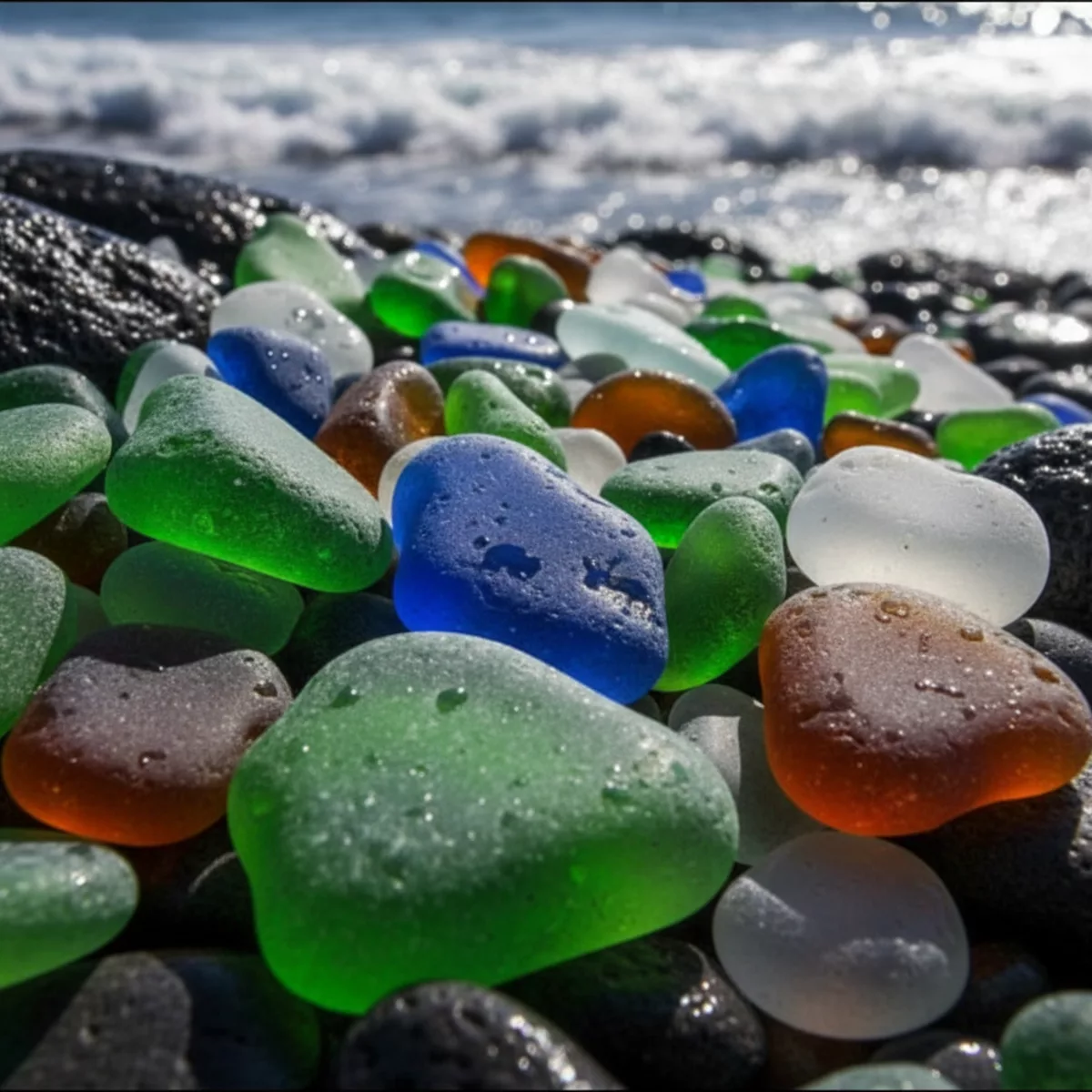
Today, the beach is carpeted with millions of smooth, rounded glass pebbles in every shade of green, blue, brown, and white. Walk along the shore at low tide and the colors are almost disorienting - bright emerald, deep amber, frosty cobalt, and pale aqua mixed together in thick layers that crunch under your feet. It's one of the most visually striking sea glass sites in the world, and it attracts collectors and photographers from across Asia and Europe.
How Soviet Dumping Created a Natural Wonder
The story of Steklyashka Beach starts in the mid-20th century, during the Soviet era. Vladivostok was a closed military city - home to the Pacific Fleet and off-limits to foreigners until 1992. Industrial activity was heavy, and waste disposal followed the standard Soviet approach: find a convenient cliff and throw everything over it.
The area around Ussuri Bay received enormous quantities of glass waste. Vodka bottles by the thousands - the iconic green and clear glass that fueled much of Soviet social life. Beer bottles in brown and amber. Wine bottles. Broken windowpanes. Porcelain dishes and ceramic tiles from demolished buildings. All of it went over the edge and into the bay.
Other industrial waste followed. The nearby factories contributed their own refuse - chemical containers, laboratory glass, and production byproducts. Some accounts suggest military waste was dumped here too, though the details are murky given the city's classified status during the Soviet period.
When the dumping finally stopped - gradually through the 1990s as environmental awareness grew and the city opened up - the Sea of Japan went to work. The waters of Ussuri Bay are cold, rough, and driven by strong tidal currents. Storms regularly pound the coastline with waves powerful enough to move heavy stones. The volcanic rock that lines the shore acts as natural grinding media, far more abrasive than sand.
The combination proved remarkably effective. Glass that might take 50 to 100 years to fully smooth on a sandy beach got ground down faster here. The angular shards became rounded pebbles. The clear surfaces developed a deep, milky frost. And because so much glass was dumped in such a concentrated area, the beach didn't just produce the occasional piece of sea glass - it became sea glass, layer upon layer of smoothed gems mixed with natural stones.
What You'll Find
Steklyashka Beach is different from most sea glass destinations in a few important ways. The sheer volume is the first thing that hits you. At Davenport Beach or Seaham, you hunt for individual pieces among normal sand and rock. At Steklyashka, the glass IS the beach. In some sections, particularly along the high-tide line, glass pebbles outnumber natural stones.
The pieces tend to be large compared to what you'd find at most beaches. Thumb-sized and larger pieces are common, and fist-sized chunks aren't unusual. The cold, rough water produces excellent frosting, and the volcanic rock creates a distinctive surface texture - slightly rougher and more matte than glass tumbled on sandy beaches.
Green dominates the color palette, which makes sense given the origin. Soviet vodka and wine bottles account for most of the glass, and they were overwhelmingly green. You'll find every shade from pale seafoam to deep emerald to olive drab.
Brown and amber pieces come from beer bottles and some medicine containers. These are the second most common color and range from honey-gold to dark chocolate brown.
White and clear glass makes up the third major category. Vodka bottles, window glass, and household items contribute clear pieces that frost into a soft, translucent white over time.
Blue pieces are less common but not rare. They come from mineral water bottles, decorative glass, and some industrial containers. Cobalt blue pieces from old medicine bottles occasionally turn up and are among the most prized finds.
Porcelain and ceramic pieces are a bonus that many collectors don't expect. Broken dishes and tiles have been tumbled alongside the glass, producing smooth white fragments, some with blue or floral patterns still visible. Soviet-era porcelain with distinctive designs turns up regularly.
What you won't find much of at Steklyashka is the ultra-rare color spectrum - reds, oranges, pinks, and purples are essentially absent. The glass source was almost entirely utilitarian Soviet-era bottles, not the art glass or Victorian factory waste that produces rare colors at places like Davenport or Seaham. If you want quantity and spectacle, Steklyashka delivers. If you want rare individual specimens, other beaches are better hunting grounds.
When to Visit
Vladivostok has a climate that surprises most visitors. Despite being at roughly the same latitude as the French Riviera, it has harsh winters influenced by Siberian air masses and cool summers moderated by the Sea of Japan.
- Best months: May through October. Summer temperatures hover around 20-25 C (68-77 F), and the weather is generally pleasant. July and August are warmest but can be foggy - the cold Liman Current creates dense fog that rolls in off the sea and can reduce visibility to almost nothing.
- After storms. Like all sea glass beaches, Steklyashka is most productive after heavy weather churns up the seabed. Typhoons occasionally reach this far north in late summer and fall, and the aftermath can deposit fresh glass on the beach.
- Low tide. The tidal range in Ussuri Bay is modest - about 0.5 meters - but low tide still exposes more glass. Check local tide tables.
- Avoid winter. November through March brings temperatures well below freezing, ice on the bay, and brutal winds. The beach is technically accessible but miserable.
- Weekday mornings. Steklyashka has become a popular tourist stop, especially with Chinese and Korean tour groups. Weekday mornings are quieter.
Is the Glass Disappearing?
This is the question that comes up every time someone writes about Steklyashka, and the honest answer is: yes, slowly.
The dumping stopped decades ago. No new glass is entering the system. Every piece that gets picked up by a tourist, washed out to deeper water, or ground down to sand-sized particles is one fewer piece on the beach. Long-time visitors report that the glass coverage has noticeably thinned since the beach became famous in the early 2010s, when photos went viral on social media.
The Russian government has taken some steps to protect the site. Steklyashka was designated a protected natural area, and technically collecting glass is discouraged. But enforcement is minimal, and most visitors take at least a handful of pieces home. Tour operators bring busloads of visitors daily during peak season, and the cumulative effect is real.
That said, the beach is still spectacular and will be for years to come. The volume of glass originally dumped was enormous, and much of it remains buried under layers of rock or sitting offshore where the currents haven't yet pushed it to the beach. New pieces continue to wash up with each storm. But if visiting Steklyashka is on your list, sooner is better than later.
Collecting Rules
The rules around collecting at Steklyashka are ambiguous. The beach has been designated as part of a protected coastal zone, and signs at the site discourage removing glass. In practice, enforcement is inconsistent. Most visitors take small amounts without issue, but organized commercial collecting would likely draw attention from local authorities.
The ethical calculation is worth considering. Unlike beaches where glass comes from ongoing natural processes or vast historical dumps, Steklyashka's supply is finite and already declining. Taking a few small pieces as a memento is one thing. Filling a bag is harder to justify when you know the beach is getting thinner year by year.
Getting to Vladivostok
Vladivostok is remote by any standard - it sits at the far eastern edge of Russia, closer to Tokyo than to Moscow. Getting there requires some planning:
- By air - Vladivostok International Airport (VVO) has direct flights from Moscow (about 8.5 hours), Seoul (2.5 hours), Tokyo (2.5 hours), and Beijing (4 hours). Several Asian carriers offer competitive fares, making Vladivostok accessible as part of a broader East Asian trip.
- By rail - The Trans-Siberian Railway terminates in Vladivostok. The full journey from Moscow takes about 6 days and covers 9,289 kilometers - the longest railway route in the world. It's an experience in itself, though not exactly efficient for a beach visit.
- Visa requirements - Russia requires visas for most nationalities, though an electronic visa (e-visa) system has simplified the process for visitors to the Russian Far East. Check current requirements before booking, as policies change frequently.
Getting to the Beach
From Vladivostok city center, Steklyashka Beach is about 30 kilometers south, near the village of Shkotovo. The drive takes roughly 30 to 40 minutes depending on traffic.
- By car or taxi - The most practical option. The road is paved most of the way, with a rough dirt track for the final stretch down to the beach. A regular car can manage it in dry conditions, but a vehicle with some clearance helps. Taxis from Vladivostok cost a reasonable fare.
- By tour - Several Vladivostok tour operators offer half-day trips to the beach, often combined with other stops along Ussuri Bay. These are the easiest option for visitors without a car.
- Public transport - Limited. Buses run to nearby villages, but the final stretch to the beach requires walking. Not ideal unless you're comfortable with Russian public transport and have time to spare.
What to Bring
- Sturdy shoes - The beach is all glass and rock. Barefoot is a bad idea. Water shoes or hiking sandals work well.
- Sun protection - In summer, the sun reflects off the glass and water intensely. Sunscreen, hat, and sunglasses are essential.
- Camera with macro capability - The glass is incredibly photogenic, especially wet. A macro lens or phone with macro mode will capture the details. Read our guide to photographing sea glass for tips.
- Water and snacks - There are no facilities at the beach. The nearest shops are in Shkotovo village.
- A small container - If you plan to take a few pieces, a small jar or bag is sufficient. Remember: take sparingly.
Steklyashka vs. Other Glass Beaches
How does Steklyashka compare to the world's other famous sea glass destinations?
- Steklyashka vs. Fort Bragg Glass Beach - Both originated as dump sites and both are protected areas. Fort Bragg has a stricter no-collecting policy. Steklyashka has larger pieces and arguably more dramatic visual impact, while Fort Bragg has more color variety from its mixed household waste. Fort Bragg is far more accessible for most travelers.
- Steklyashka vs. Seaham Beach - Opposite ends of the spectrum. Seaham produces fewer pieces but in extraordinary rare colors from Victorian factory glass. Steklyashka produces massive quantities in mostly common colors from Soviet bottles. Seaham is for the collector who values individual specimens; Steklyashka is for the person who wants to see an entire beach made of glass.
- Steklyashka vs. Glass Beach, Kauai - Both feature high concentrations of glass in tropical (Kauai) or temperate (Steklyashka) settings. Kauai's glass is generally smaller and more rounded. Steklyashka has larger, chunkier pieces. Kauai is obviously more accessible and pleasant for a casual visit.
Nearby Attractions
If you've come all the way to Vladivostok, the city itself deserves a few days. The Golden Horn Bay resembles San Francisco's harbor, and the city has undergone a major transformation since the 2012 APEC summit brought new bridges, roads, and a renovated waterfront. The Primorsky Aquarium on Russky Island is world-class, and the local seafood - particularly king crab and sea urchin - is some of the best in Russia.
Along the coast south of the city, several other beaches in Ussuri Bay are worth exploring for sea glass. The dump sites weren't limited to Steklyashka, and smaller accumulations of glass turn up along the whole southern shore.
More Sea Glass Locations
Exploring the world's best sea glass beaches? Browse our complete list of sea glass locations, or check out the legendary Davenport Beach in California for art-quality multi-colored glass. For another beach born from industrial history, read about Spectacle Island in Boston Harbor, where a former city dump produces century-old glass and pottery.
New to sea glass collecting? Our beginner's guide covers everything you need to get started, and our color rarity chart will help you identify what you've found.