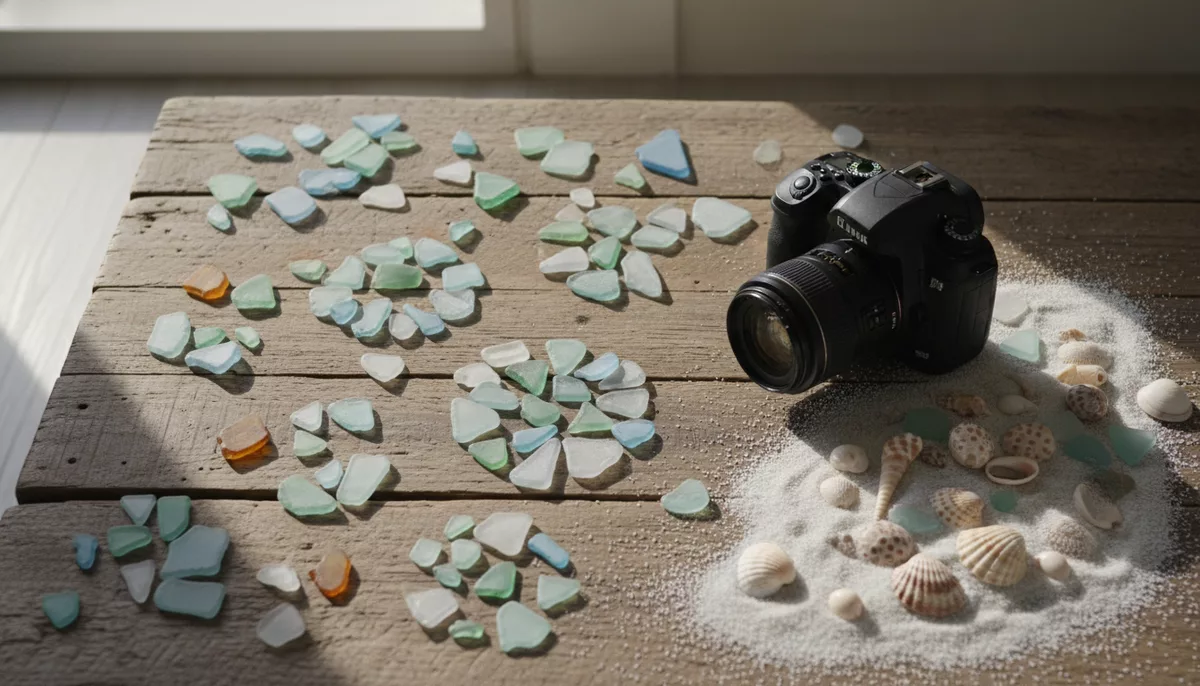
You found an incredible piece of red sea glass on the beach. You pull out your phone, snap a photo, and... it looks like a dull brown pebble. The color is wrong, the frost doesn't show, and that gorgeous translucence is nowhere to be seen.
This is the single biggest frustration for sea glass collectors who sell online or share their finds on social media. Sea glass is notoriously difficult to photograph because its beauty depends on light passing through and scattering off the frosted surface - something that flat, direct lighting completely kills.
The good news: you don't need expensive equipment to take sea glass photos that look as good as the glass does in person. What you need is an understanding of how light interacts with frosted glass, and a few simple techniques that work with any camera, including your phone.
Why Sea Glass Is Hard to Photograph
Most objects are straightforward to photograph because their color comes from light bouncing off a solid surface. Sea glass is different. It's translucent, so light passes through it and scatters off millions of tiny surface pits created by decades of wave action. That scattering is what gives sea glass its distinctive glow - and it's the first thing that disappears in a bad photo.
Direct light creates harsh reflections on the frosted surface that blow out the color. Overhead light makes pieces look flat and lifeless. Dark backgrounds absorb the light that should be passing through the glass. Camera auto-exposure sees the bright glass against a background and splits the difference, leaving the glass overexposed and washed out.
Once you understand these problems, the solutions are simple. Every tip in this guide comes back to one principle: control the light so it reveals the glass instead of fighting it.
Lighting: The Most Important Factor
If you learn nothing else from this guide, learn this: indirect natural light from the side is the key to sea glass photography. Not direct sun, not overhead light, not your camera flash. Side-lit, diffused natural light.
The Window Light Setup
The easiest and most reliable lighting setup requires nothing but a window and an overcast day - or a sheer curtain on a sunny day. Place your sea glass on a flat surface next to a north-facing window (north-facing gets consistent, indirect light throughout the day). The light should come from one side, hitting the glass at roughly a 45-degree angle.
This side lighting does two things that matter. First, it creates soft shadows on the opposite side of each piece, giving them three-dimensional depth. Second, it enters the glass from an angle, which makes the color glow from within rather than bouncing off the surface.
If the shadows are too harsh, place a piece of white posterboard on the opposite side of the glass from the window. This bounces some of the window light back into the shadows, filling them in without adding a second light source. Photographers call this a "bounce card" and it's one of the most useful tools in product photography.
Backlighting for Color
When color accuracy is your priority - for example, photographing a rare color you're trying to identify or sell - backlighting reveals the true hue better than any other technique. Place the glass on a lightbox, a tablet screen set to full white, or simply hold it up to a bright window.
Backlighting makes the color pop because you're seeing the light that transmitted through the glass rather than the light that bounced off it. A piece of lavender sea glass that looks gray in normal light will glow unmistakably purple when backlit. Cobalt blue becomes electric. Even common green and white pieces look dramatically more interesting.
The downside of backlighting is that it can obscure the frost quality. A heavily frosted piece and a lightly frosted piece look similar when backlit because the light overwhelms the surface texture. So use backlit shots for color, but include front-lit shots too for buyers or collectors who care about surface condition.
Avoid These Lighting Mistakes
Camera flash: Never use flash for sea glass. The burst of direct light creates a single hot spot on the frosted surface that blows out the color in that area while leaving the rest of the glass dark. It's the worst possible lighting for translucent objects.
Direct sunlight: Harsh overhead sun creates strong shadows and specular highlights - bright white spots on the glass surface where the light reflects directly into your camera. The color looks washed out and the frost texture disappears.
Mixed lighting: Don't combine window light with indoor lamps. Daylight is blue-toned, incandescent bulbs are orange-toned, and fluorescent lights are green-toned. Mixing them creates weird color casts that make your sea glass look off. Stick to one light source, preferably natural daylight.
Backgrounds That Work
Your background should make the sea glass stand out without competing with it. The glass is the subject - everything else is supporting context.
For Selling Online
White or near-white backgrounds are the standard for selling sea glass on Etsy, eBay, and other platforms. They show accurate color, look clean in listings, and make it easy for buyers to compare pieces across different sellers. A sheet of white posterboard costs a dollar and creates a seamless background when curved up behind the glass.
Light gray and soft linen textures are popular alternatives that add some visual warmth without distracting from the glass. A natural linen napkin or piece of unbleached cotton gives texture to what might otherwise feel clinical.
For Social Media and Portfolio Shots
Contextual backgrounds tell a story. Weathered driftwood suggests the beach. Smooth river stones reference the water that made the glass. Wet sand with a shallow wave edge creates a "just found it" feeling that resonates with other collectors.
Dark backgrounds can work well for lighter-colored glass - white, seafoam, and pale blue pieces pop against dark slate or wet black stone. But avoid dark backgrounds for darker glass (cobalt blue, deep green, brown) because the pieces disappear into the background.
Backgrounds to Avoid
Busy patterns, colorful fabrics, and cluttered surfaces pull attention away from the glass. Printed paper, tile with visible grout lines, and wood with heavy grain all compete visually. If you notice yourself looking at the background instead of the glass, it's the wrong choice.
Wet vs. Dry: Photograph Both
This is one of the most debated topics in sea glass photography, and the answer is simple: shoot both.
Dry sea glass shows the frosted surface that collectors use to judge quality and authenticity. The frost is what distinguishes real sea glass from manufactured imitations, and serious buyers want to see it clearly. A well-frosted piece photographed dry looks soft, almost velvety, with a matte finish that's unmistakable.
Wet sea glass shows the true color. Water temporarily fills the microscopic pits that create the frost, making the glass more transparent and revealing the color intensity underneath. A piece that looks pale gray when dry might show itself as light purple when wet. For rare colors, the wet shot is what gets buyers excited.
For selling, include at least one dry shot (frost quality) and one wet shot (color accuracy) per piece. For social media, wet glass is more visually striking and tends to get more engagement. A wet piece of cobalt blue sea glass against white sand is one of those images people stop scrolling for.
To wet glass for photos, dip it briefly in clean water and photograph immediately. The water evaporates quickly, so work fast. Don't use oils or glycerin to keep it wet-looking - collectors can tell, and it erodes trust.
Camera Settings and Technique
Smartphone Tips
Modern phones take excellent sea glass photos with a few adjustments. Tap the glass on your phone screen to focus on it, then tap-hold to lock the focus point. On most phones, you can then drag a sun icon up or down to adjust exposure - drag it down slightly to prevent the glass from looking washed out.
Use portrait mode sparingly. It works well for single standout pieces where you want a blurred background, but it sometimes misinterprets the edges of translucent glass and blurs parts of the piece itself. Check the results at full zoom before relying on it.
The macro lens on newer phones (iPhone 13 Pro and later, Samsung S21 Ultra and later) is excellent for sea glass closeups. It captures frost texture and surface details that a normal lens can't resolve. Get close enough that the piece fills about two-thirds of the frame.
DSLR and Mirrorless Settings
If you have a dedicated camera, these settings produce consistently good results:
- Aperture: f/5.6 to f/8 for single pieces (sharp focus with slight background blur). f/11 to f/16 for group shots where you need everything sharp.
- ISO: As low as your camera allows - ISO 100 or 200. Higher ISO introduces noise that muddies the subtle surface texture.
- White balance: Daylight or auto. If shooting under window light, daylight white balance usually produces the most accurate colors.
- Lens: A 50mm prime or 100mm macro lens. Macro lenses let you fill the frame with a single piece and capture surface detail that wider lenses miss.
- Tripod: Use one. At f/8 and ISO 100, your shutter speed will be slow enough that hand-holding introduces blur. A phone tripod adapter works fine.
Focus and Depth
For single pieces, focus on the top surface of the glass - specifically on the frost texture. This is what the viewer's eye is drawn to first. A slightly soft focus on the edges is fine and actually looks more natural than razor-sharp edges.
For group arrangements, you need a smaller aperture (higher f-number) to keep all the pieces sharp. But don't go beyond f/16 - diffraction starts softening the image at very small apertures, and you'll actually lose sharpness. If you can't get everything sharp at f/16, try shooting from directly overhead instead of at an angle. Reducing the depth of the scene reduces how much depth of field you need.
Composition and Arrangement
Single Piece Shots
When photographing one special piece, fill the frame. The glass should occupy at least half the image area. Leave a little space around it so it doesn't feel cramped, but don't leave so much space that the glass becomes a small dot in a sea of background.
Try multiple angles. Flat overhead shots show shape and color. 45-degree angle shots show thickness and frost quality. Low-angle shots with the glass slightly backlit create dramatic, gallery-style images.
Group Arrangements
Sorting by color gradient - from white through green to blue to the rare colors - creates visually satisfying arrangements that also communicate rarity. It's the reason our color rarity chart is one of the most visited pages on this site.
Odd numbers look better than even numbers. Three pieces of different sizes, five colors in a row, seven pieces in a loose scatter. There's a visual tension to even numbers that makes arrangements feel rigid.
Leave breathing room between pieces. Touching or overlapping glass makes individual pieces hard to distinguish. A gap of roughly one piece-width between items keeps the arrangement readable.
Scale Reference
Always include at least one photo with a size reference, especially if you're selling. A US quarter is the standard in the sea glass community because its 24mm diameter is well-known and roughly the size of average sea glass. Place it next to - not on top of - the glass.
Editing: Less Is More
The goal of editing sea glass photos is to match what your eyes saw in person, not to create something that looks better than reality. Over-edited sea glass photos erode trust with buyers and collectors who know what real sea glass looks like.
Exposure and brightness: Adjust so the white or lightest part of the background is just barely below pure white. This ensures accurate color representation.
White balance correction: If the glass looks too warm (yellowish) or too cool (bluish), adjust the temperature slider until it matches what you see in person. This is the most important edit for color accuracy.
Contrast: A small boost (10-15%) helps the glass stand out from the background without looking artificial.
Saturation: Do not increase saturation. This is the single most common mistake in sea glass photography. Boosted saturation makes colors look unnaturally vivid, and experienced collectors and buyers will immediately distrust your listings. If anything, you can pull saturation back by 5% to counteract the slight over-saturation most cameras introduce. Use the sea glass value guide as a reference for what natural sea glass colors should look like.
Sharpening: A small amount of sharpening (25-35% in Lightroom, or the "sharpen" filter at low intensity in phone apps) can help bring out frost texture without making the image look crunchy.
Photographing Sea Glass for Different Purposes
For Selling Online
Buyers need accurate information. Include: one overall shot on white background (color and shape), one macro closeup (frost and surface condition), one wet shot (true color), one with scale reference (size), and one lifestyle shot if it's jewelry (how it looks worn). Five photos per listing is the sweet spot - enough to show everything, not so many that it feels overwhelming.
For Insurance or Appraisal
If you have a valuable collection, document it with clinical precision. White background, consistent lighting, ruler for scale, dry glass only. Shoot each piece individually and include a wide shot of the entire collection. Date-stamp the photos and store copies in cloud storage. These photos establish provenance and condition.
For Social Media
Social media rewards emotion over information. Wet glass on a beach, golden hour light, a single stunning piece filling the frame. These aren't the shots that sell glass, but they're the shots that build an audience of people who will eventually buy from you.
Quick Reference Checklist
- Use indirect natural light from the side - never flash
- Photograph wet AND dry versions
- White background for selling, natural surfaces for social media
- Include a quarter for scale in at least one shot
- Focus on frost texture, not the edges
- Don't boost saturation - ever
- Shoot at phone level or 45 degrees, not from directly above (unless doing group arrangement)
- Use a bounce card (white paper) to fill shadows
- Edit minimally - match reality, don't exceed it
Good photography turns a nice piece of sea glass into a sale. It turns a personal collection into content that draws other collectors to your blog or shop. And it preserves the beauty of finds that might otherwise live in a jar on a shelf, appreciated only by you. Grab a window, grab your phone, and start experimenting - your glass deserves to be seen the way you see it in person.
Frequently Asked Questions
What is the best camera for photographing sea glass?
A smartphone with a good camera works perfectly well for most sea glass photography. iPhones from the 12 and up, Samsung Galaxy S series, and Google Pixel phones all produce sharp macro-style shots. If you have a DSLR or mirrorless camera, a 50mm or 100mm macro lens will give you the most control. The lighting matters far more than the camera body - a $200 phone with great natural light will outperform a $3,000 camera with bad lighting every time.
How do you photograph sea glass without glare?
Shoot in indirect natural light rather than direct sunlight. Position your sea glass near a window but not in the direct beam of sun. If you're getting glare spots, put a white sheet or curtain between the window and the glass to diffuse the light. Shooting on overcast days eliminates glare almost completely. You can also try misting the glass lightly with water - the water fills in surface irregularities that cause hot spots.
Should sea glass be wet or dry for photos?
Both work, but they create very different looks. Dry sea glass shows the frosted, matte surface that collectors value. Wet sea glass reveals the true color underneath and looks more vibrant and saturated. For selling purposes, photograph each piece both ways. The dry shots show authenticity and frost quality. The wet shots show color intensity and give buyers a better sense of the actual hue, especially for subtle colors like lavender and soft blue.
What background works best for sea glass photos?
White and neutral backgrounds are best for showing accurate color, which is critical for selling. A sheet of white posterboard, a marble tile, or a piece of linen fabric all work well. For more stylistic shots, weathered driftwood, sand, and smooth river stones create a natural context. Avoid busy patterns or bright colors that compete with the glass. Whatever you choose, keep it consistent across your photos so your collection or shop listings look cohesive.
How do you show sea glass size in photos?
Place a common object next to the glass for scale. A US quarter (24mm diameter) is the standard reference in the sea glass community. You can also use a ruler or measuring tape, but coins feel more natural in the photo. For Etsy and online selling, include one scale reference photo plus closeups without the coin so buyers can appreciate the surface detail and frost quality without distractions.