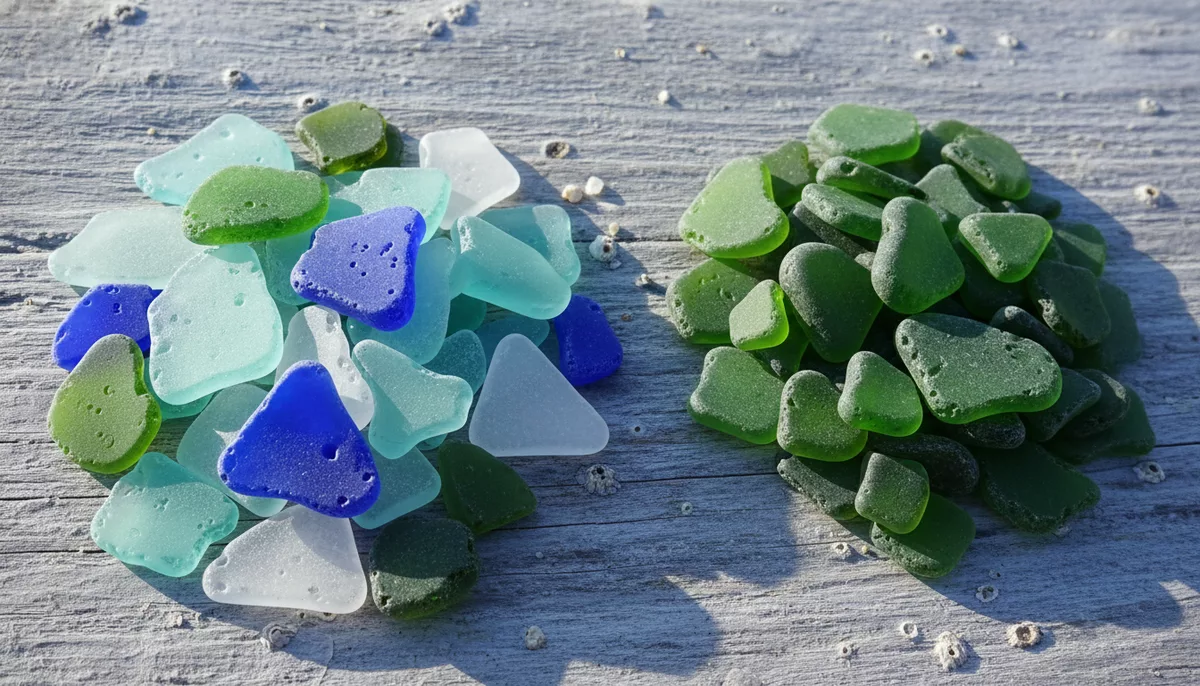
If you've spent any time browsing sea glass on Etsy, eBay, or at a craft fair, you've probably noticed something: a lot of it doesn't look quite right. The colors are too uniform. The shapes are too perfect. The frosting looks like it came out of a spray can. And in many cases, that's exactly what happened - or close to it. Machine-tumbled craft glass is sold as "sea glass" constantly, and if you don't know what to look for, it's easy to get fooled.
This matters if you're buying sea glass for a collection, for jewelry, or just because you appreciate the real thing. Genuine sea glass spent decades - sometimes a century or more - being shaped by the ocean. Craft glass spent a few days in a rock tumbler with silicon carbide grit. The two products are fundamentally different, and once you know the tells, you'll never confuse them again.
Why Fake Sea Glass Exists
Real sea glass is getting harder to find. As beaches get cleaned up and glass bottles get replaced by plastic, the supply entering the ocean has dropped dramatically since the 1970s. But demand has gone the other direction - sea glass jewelry, home decor, and collecting have all grown in popularity. That gap between supply and demand created a market for manufactured alternatives.
Craft glass manufacturers take regular glass (often in colors that would be genuinely rare as sea glass, like red or cobalt blue), break it into pieces, and tumble it in industrial rock tumblers with abrasive grit and water. In three to five days, the glass comes out with rounded edges and a frosted surface. It looks decent in photos. At scale, it costs pennies per piece.
There's nothing inherently wrong with tumbled craft glass. It works perfectly well for mosaic projects, aquarium decorations, and bulk craft supplies. The problem is when it's sold as the real thing, at real sea glass prices, to buyers who don't know the difference. A genuine piece of rare red sea glass might sell for $30 to $100 depending on size and quality. A tumbled red craft glass piece costs about five cents to produce.
The Surface Texture Test
This is the single most reliable way to tell real sea glass from fake, and it requires nothing more than a cheap magnifying glass or a phone camera on macro mode.
Genuine sea glass develops its frosted surface through a process called hydration. Over decades in salt water, the sodium ions in the glass are slowly replaced by hydrogen ions from the water. This creates a microscopically thin layer of silica gel on the surface - that's what gives real sea glass its distinctive soft, matte finish. The process isn't uniform. It happens faster on some areas than others, depending on the glass composition and which parts were most exposed to water and abrasion.
Under magnification, you'll see tiny C-shaped marks scattered across the surface. These are conchoidal fractures - the signature pattern that sand grains leave when they strike glass at varying angles and velocities in the surf. The pattern is random and organic. No two square millimeters look exactly the same. Some areas might be more heavily frosted than others. You might see spots where the original glass surface peeks through, especially in recessed areas where sand couldn't reach as effectively.
Machine-tumbled glass looks different under the same magnification. Instead of C-shaped marks, you'll see either straight parallel scratches (from the grit moving in one direction) or uniform pitting that looks too regular. The frosting is consistent across the entire surface because the tumbling process is uniform - every part of the glass gets the same treatment. Real ocean action doesn't work that way. Waves come from different directions, sand varies in coarseness across the ocean floor, and glass pieces flip, roll, and settle in unpredictable ways over decades.
The Shape Test
Pick up a piece of genuine beach-found sea glass and look at its overall shape. It's irregular. The edges curve in unexpected ways. One side might be thicker than the other. The piece might have a slight twist or warp. It doesn't look like it was designed - it looks like it was shaped by accident over a very long time, because that's exactly what happened.
Tumbled craft glass tends toward predictable shapes. The tumbling process rounds off sharp edges uniformly, producing pieces that look like flattened pebbles or smooth ovals. They're often suspiciously similar in size and shape to other pieces in the same batch. If you're looking at a collection where every piece is roughly the same thickness, roughly the same size, and roughly the same degree of roundedness, that's a strong sign of machine tumbling.
Real sea glass also shows evidence of its origin. You might see a slight curve from the original bottle. A piece might have one flat side (from the bottle's base) and one curved side (from the wall). Thicker pieces might show a seam line where the bottle mold joined. These manufacturing marks survive ocean tumbling because the glass was shaped for functional reasons, and the ocean just softens them rather than erasing them entirely. Craft glass, which starts as flat-broken shards, rarely shows these features.
The Edge Test
Run your finger along the edge of a genuine piece of sea glass. It should feel smooth but not sharp - like a worn stone. The edge isn't perfectly uniform. Some spots might be slightly rougher than others. There might be subtle undulations where the glass wore unevenly. The transition from the face of the glass to the edge is gradual and organic.
Craft glass edges tend to be either too sharp (not tumbled long enough) or too uniformly rounded (tumbled with aggressive grit). The transition from face to edge is often abrupt - a clear line where the flat surface meets the rounded edge. On real sea glass, that transition is blurred by decades of natural wear.
One specific detail to check: look at the edge in profile. Real sea glass edges often have a slight "lip" or unevenness where different layers of glass wore at different rates. Craft glass edges are usually smooth and consistent because the tumbling wears everything at the same rate.
The Frosting Test
Genuine sea glass frosting has a quality that's hard to describe but easy to recognize once you've handled enough of it. The best word might be "soft." It looks like the glass has a natural patina - almost like it's been lightly dusted with something. The frosting varies across the surface. Areas that were more exposed to sand and surf are more heavily frosted. Protected areas - inside curves, recessed spots, areas near thicker glass - show less frosting or even patches of the original glassy surface.
Craft glass frosting looks sprayed on. It's uniform. Every part of the surface has the same degree of opacity. There's no variation, no natural gradient. Some manufacturers add an acid etch or sandblasting step to simulate frosting, and this is even easier to spot - acid-etched glass has an unnaturally smooth frosted surface without the micro-texture that ocean tumbling creates.
Here's a quick test: breathe on the glass like you're fogging a mirror. On genuine sea glass, your breath will condense slightly differently on the hydrated surface layer, sometimes revealing the C-shaped patterns more clearly. On craft glass, the condensation is uniform. This isn't foolproof, but it's a quick field check.
The Color Test
Color is trickier because both real and fake sea glass come in all colors. But there are patterns that should raise your suspicion.
If someone is selling a large quantity of rare colors - red, orange, yellow, pink - at prices that seem too good to be true, they almost certainly are. Genuine rare sea glass colors like red and orange represent less than 1 in 5,000 pieces found on most beaches. Nobody is finding bags full of red sea glass. If a seller has a mason jar of red "sea glass" for $15, it's tumbled craft glass.
Also watch for colors that don't match historical glass production. True black sea glass is extremely rare and always very old (1700s-1800s). Bright teal, neon pink, or electric blue suggest modern decorative glass that was tumbled, not genuine vintage glass that spent decades in the ocean. Real sea glass colors are generally muted by the frosting process - they don't pop with the same vibrancy as new craft glass.
That said, certain beaches do produce unusual colors in legitimate quantities. Seaham Beach produces multi-colored art glass from the Victorian-era Londonderry Bottleworks. Davenport Beach yields rare reds and oranges from the Lundberg glass studio. But these pieces still show all the other hallmarks of genuine ocean tumbling - the surface texture, the irregular shape, the variable frosting.
The Weight and Feel Test
This one takes experience, but experienced collectors can often tell real from fake just by holding a piece. Genuine sea glass that's been in the ocean for 50+ years has a particular feel - the hydrated surface layer gives it a slightly different texture than raw glass. Some collectors describe it as "waxy" or "soapy." It's subtle, but it's there.
Weight can also be a clue. Old glass - the kind that becomes genuine sea glass - was often denser than modern glass because manufacturing processes were less refined and glass recipes included more lead or other heavy metals. A piece of old bottle glass will sometimes feel heavier than you'd expect for its size. Modern craft glass, made from thin and lightweight recycled glass, often feels too light.
This test doesn't work in isolation. But combined with the other tests, it adds another data point. If the surface texture, shape, frosting, and weight all check out, you can be pretty confident you're holding the real thing.
Common Fakes and How to Spot Them
Rock Tumbler Glass
The most common fake. Broken glass run through a rotary tumbler with progressively finer grit. Telltale signs: overly uniform shape, consistent frosting, straight scratches visible under magnification, and often sold in bulk at low prices. Quality varies - some high-end tumbled glass is harder to spot, but the surface texture under magnification always gives it away.
Acid-Etched Glass
Glass dipped in or sprayed with hydrofluoric acid to create a frosted surface. The result is a smooth, silky frosting without any of the micro-texture that ocean tumbling creates. Under magnification, the surface looks flat and featureless - no C-shaped marks, no pitting, just a uniform haze. The edges often remain sharper than real sea glass because acid etching doesn't physically round the glass.
Sandblasted Glass
Similar to acid etching but uses high-pressure sand to create the frosted surface. Produces a slightly more textured surface than acid etching, but the pattern is still more uniform than genuine ocean tumbling. The abrasion marks tend to be more angular and directional than the random C-shapes found on real sea glass.
"Beach Glass" Relabeling
Some sellers use "beach glass" to describe glass found on lake shores or riverbeds. This glass is tumbled by freshwater action rather than ocean surf, and while it's genuinely natural, it looks different from sea glass. Lake and river glass typically has lighter frosting (freshwater doesn't hydrate glass surfaces the way salt water does) and less rounding. It's not fake, but it's not sea glass either. Sellers who label it as "sea glass" without noting its freshwater origin are being misleading.
Where Fake Sea Glass Shows Up Most
Online marketplaces are the biggest source of misrepresented craft glass. Etsy, eBay, and Amazon all have sellers mixing tumbled glass in with genuine pieces or selling it outright as "sea glass." Tourist shops near popular beaches sometimes carry manufactured glass labeled ambiguously.
The best protection is buying from sellers who disclose their sourcing. Reputable sea glass sellers will tell you which beach the glass came from and often provide close-up photos showing the natural surface texture. They might include a certificate of authenticity or at least a description of how and where the glass was collected. If a seller can't or won't tell you where the glass came from, be cautious.
Collecting your own glass from the beach is the surest way to know it's genuine. Visit known sea glass locations like Fort Bragg Glass Beach or Spectacle Island, and every piece you pick up is guaranteed real. There's no substitute for the experience of finding your own piece after an hour of walking the tideline. Timing your visit right makes a big difference too - check our seasonal guide to know when conditions are best.
Does It Really Matter?
If you're buying sea glass for a mosaic or a vase filler, honestly? No. Craft glass looks fine for decorative purposes and costs a fraction of the real thing. Use it for crafts without guilt.
But if you're collecting, making fine jewelry, or simply value authenticity, yes - it matters a lot. A genuine piece of sea glass is a connection to history. That frosted shard of cobalt blue might have been a Milk of Magnesia bottle from the 1940s. That chunk of dark olive glass could be from a rum bottle that sank in the 1800s. The ocean spent decades shaping each piece into something unique. That story, and the time it represents, is the whole point of collecting.
Machine-tumbled glass has no story. It was a wine bottle last Tuesday.
For more on building your collection with genuine pieces, check out our sea glass color rarity chart - it'll help you know what you've found and what it's worth. And if you're just starting out, our beginner's guide to sea glass collecting covers where to look, what to bring, and how to develop your eye.
Frequently Asked Questions
Can you tell real sea glass from fake just by looking at it?
Usually, yes. Genuine sea glass has irregular frosting with tiny C-shaped marks (conchoidal fractures), uneven edges, and an organic shape. Craft glass tends to have uniform frosting, overly rounded edges, and consistent thickness. With practice, the differences become obvious at a glance. A cheap magnifying glass makes it even easier - the surface texture under magnification is the most reliable single test.
Is craft sea glass worth anything?
Craft or tumbled glass has very little collector value. It works fine for craft projects, mosaics, and decorations, but serious collectors and jewelry makers pay a premium specifically for genuine ocean-tumbled glass. A single authentic rare-color piece can be worth more than a pound of tumbled craft glass. If you're selling, always be transparent about whether glass is genuine or tumbled.
How long does it take for real sea glass to form?
Genuine sea glass takes 20 to 50 years of ocean tumbling to develop proper frosting and smooth edges. Some pieces from the 1800s have been tumbling for over a century. Machine-tumbled craft glass is produced in a rock tumbler in about 3 to 5 days, which is why the surface texture is so different. The decades of natural chemical and physical weathering can't be replicated in a few days.
What is the C-shape test for sea glass?
Under magnification, genuine sea glass shows tiny C-shaped marks called conchoidal fractures on its surface. These are created by decades of being struck by sand particles in the surf. The pattern is random and irregular - no two areas look exactly alike. Machine-tumbled glass shows straight scratches or uniform pitting instead, because the abrasion process in a tumbler is fundamentally different from ocean wave action.