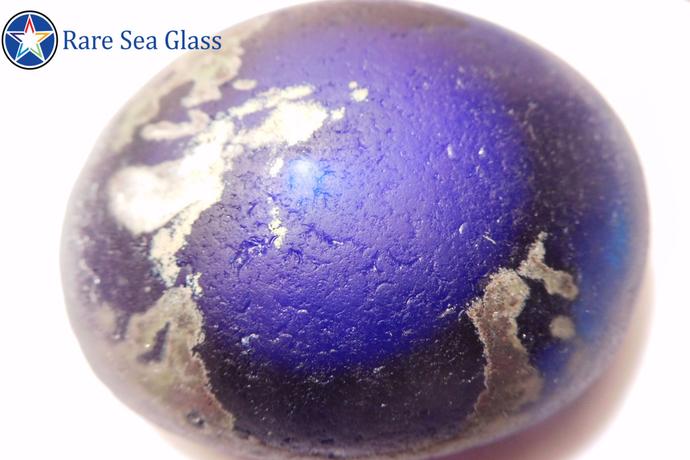
One of the best aspects of searching for sea glass at Davenport is the wide variety of different colors and shapes of glass that can be found. You just never know exactly what you'll find with the next piece that you pick up. The variety is immense compared to most beaches, and those who collect there quickly learn about the different types of sea glass they hope to one day find.
There are a wide variety of names given to describe the different pieces found at Davenport Beach by those who find sea glass there. These include mushrooms, onions, star canes and starbursts to name just a few. Another type of sea glass coveted by many collectors at Davenport is the "world globes" or "earth" pieces.
Tracing the Origin: Lundberg Studios
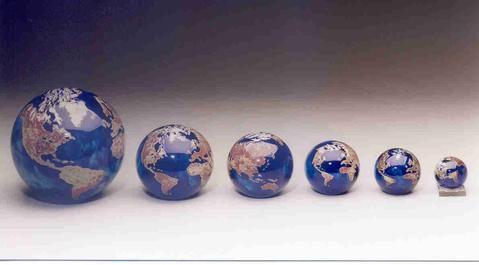
While it can often be difficult to identify exactly where a piece of sea glass came from at Davenport, the world globe pieces are ones that can often be identified. One of the art glass pieces Lundberg Studios is most famous for are their world globe paperweights. The studio, which operated near Davenport for decades, produced these intricate paperweights featuring detailed representations of the Earth - continents rendered in brown glass over a base of vivid color. When scraps and cullet from production were discarded and eventually found their way to the beach, the distinctive landmass patterns survived the tumbling of the ocean.
These are mostly done in a cobalt blue:
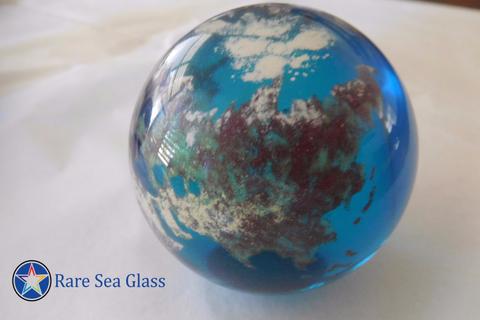
Although there are other colors as well, such as teal:
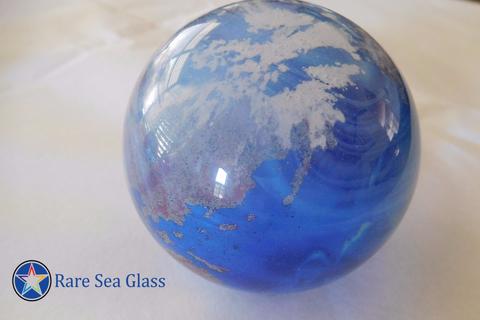
And there can be variations such as ones with cloud cover:
Identifying World Globe Sea Glass
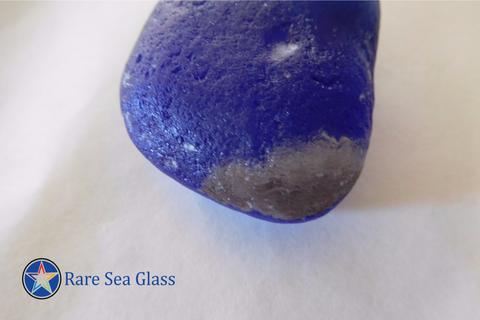
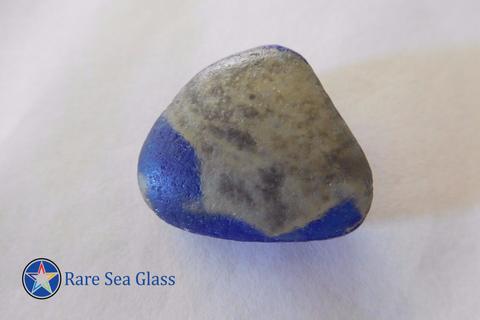
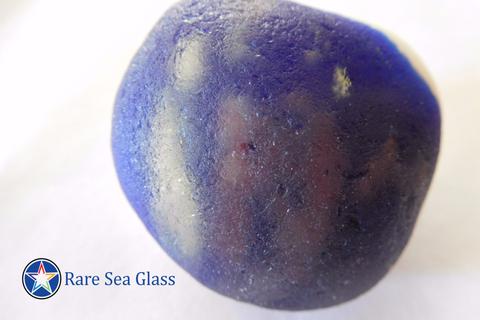
What all world globe pieces have in common are land masses done in brown (or white in the regions covered in snow) to represent the different continents of the world. It's these landmasses which make it possible to identify the world globe sea glass. Even a small fragment, if it contains a recognizable patch of brown against a blue or teal background, can often be identified as a globe piece.
The brown glass used for the continents is more opaque than the translucent base color, so it tends to stand out even after years of tumbling in the surf. Collectors who know what to look for will often spot these patterns before they even pick up the piece.
Below are some samples of world globe pieces found at Davenport Beach:
Why Collectors Value World Globe Pieces
The world globe pieces are highly sought after by Davenport collectors and most hunters strive to add at least one quality piece to their collection. What makes them special, beyond their beauty, is their identifiability. Most sea glass at Davenport is a mystery - you can appreciate the color and the frosting, but you rarely know exactly what it was before the ocean got to it. Globe pieces are different. You can hold one up and know with reasonable certainty that it started life as a Lundberg Studios world globe paperweight. That connection to a specific artist and a specific craft gives these pieces a story that other sea glass lacks.
Larger pieces with clearly visible continents command the highest interest among collectors. A fragment big enough to show, say, North America or Africa in recognizable form is considerably more desirable than a small chip that might show only an ambiguous brown streak. The most prized pieces retain enough of the original curvature that you can still sense the spherical shape of the paperweight they came from.
Related Reading
- Where Does Davenport Sea Glass Come From? - The full origin story of Davenport's art glass, including Lundberg Studios
- How to Get to Davenport Beach - Directions and parking for visiting Davenport
- Davenport Beach Location Guide - Complete guide to sea glass hunting at Davenport
- Davenport Sea Glass Mushrooms - Another rare collectible from the glass blowing process
- Browse All Archives - More posts from our 2017 collection